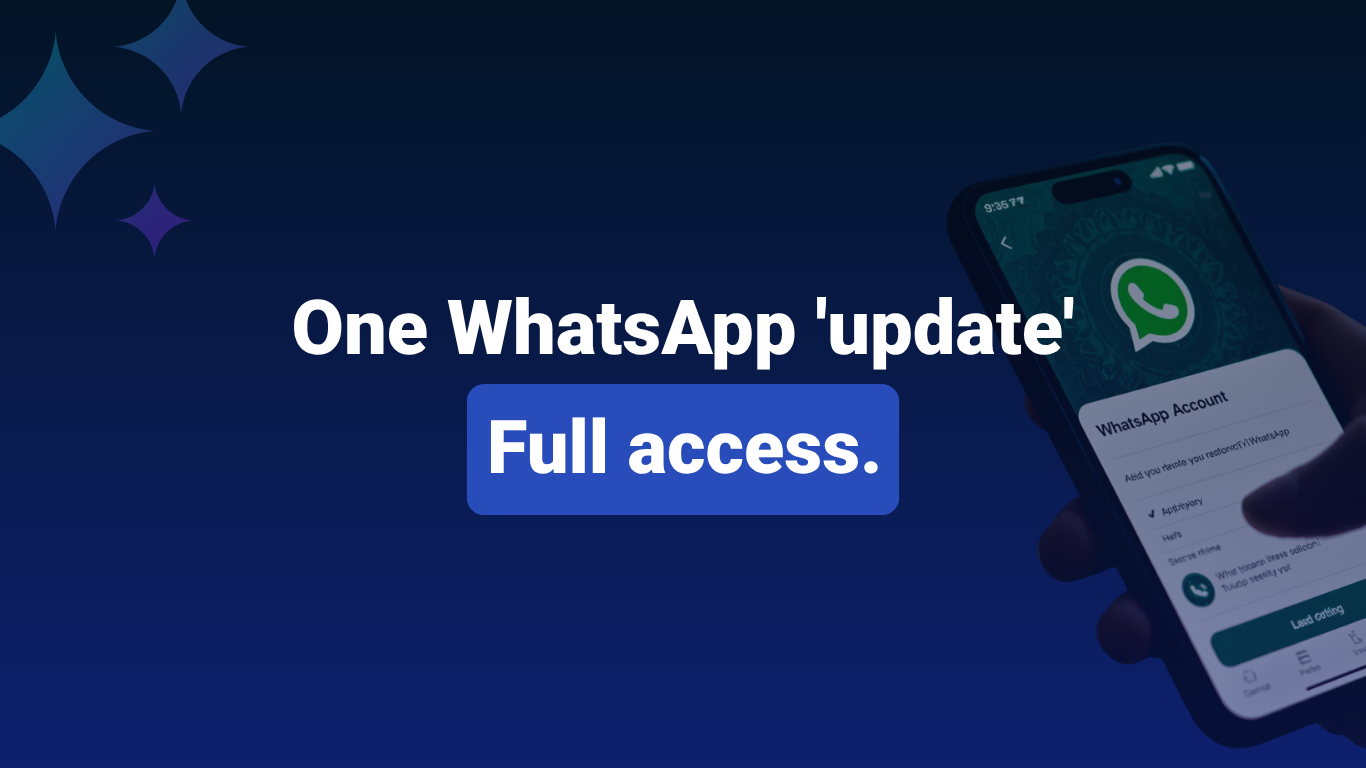
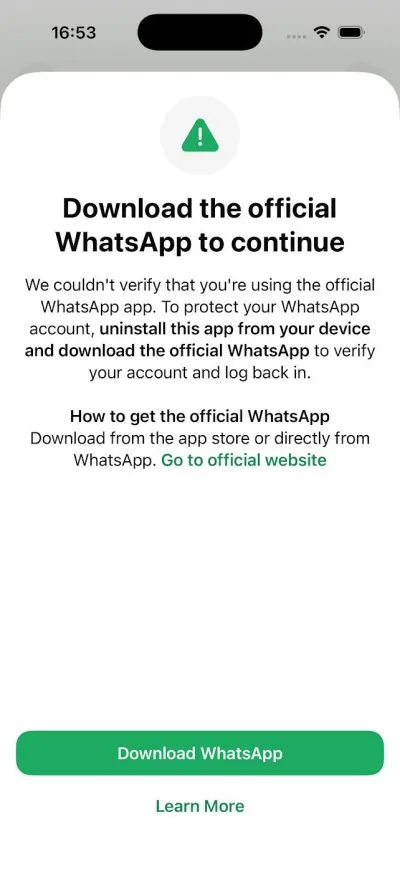
In early April 2026, WhatsApp officially alerted approximately 200 high-value individuals – including corporate executives, journalists, and government officials—that they had been targeted by a highly sophisticated spyware campaign. The method was deceptively simple: attackers used counterfeit versions of the app to trick targets into installing a “critical security update” outside of official stores. For Small and Medium-sized Enterprises (SME), this isn’t just a tech headline; it’s a direct warning that the most responsible behavior of your staff—maintaining device security—is now being weaponized by hackers to bypass enterprise defenses.
The irony of security: A trap for the conscientious
Imagine this scenario: An employee wants to ensure their work mobile is protected and sees a professional-looking notification for a WhatsApp update. Nothing unusual at first glance. Out of habit and a sense of duty, they click ‘Install’ to keep the device up to date. In that single second, your corporate perimeter is breached. The irony in 2026 is brutal: it’s precisely the attempt to ensure security that opens the door to the spy. A compromised phone no longer just means the loss of private data; it’s basically a cloned master key to your financial systems and customer databases.
Shadow IT: The invisible crack in your defences
In Germany, business flexibility and success are based on hybrid working and BYOD (Bring Your Own Device). But when employees use the same device for private chats and sensitive company emails, this security boundary disappears. Such incidents reveal the hallmark of modern attacks: hackers no longer try to ‘break through’ your firewall; they simply ask your employees for the ‘key’ through psychological manipulation. For many German SMEs, this invisible breach turns into an irreversible act of industrial espionage through an unconscious tap.
Why your current security is just an alarm, not a security guard
Many company managers believe that basic antivirus software is sufficient. But there is a crucial difference: traditional software is like an alarm system. It makes a noise, but if no one reacts at 3:00 am, the thief gets away anyway. Furthermore, if your employee manually clicks ‘Allow access’, the software assumes it’s a legitimate human decision and remains silent. In a typical SME, IT resources are limited. Without continuous monitoring, an attack at the weekend gives hackers a 48-hour head start to steal your data.
Why you should choose NovaMDR™
Professional response as your competitive advantage
As purely technical defences have reached their limits, you need a dynamic solution that combines technology with human intelligence. This is where Managed Detection and Response (MDR) comes into play. Our MDR service creates an intelligent shield through bespoke behavioral modeling. We do not believe in ‘one-size-fits-all’ solutions. Instead, our platform learns your company’s unique ‘digital DNA.’ If an employee’s device shows atypical data flows (even if the software has a ‘legitimate signature’), our system raises the alarm immediately.
The final line of defence with local experts
Important: Cyberattacks don’t stick to office hours, and your team needs breaks. If an employee triggers a high-risk alert outside working hours, you shouldn’t have to wade through English manuals or wait for a response from an overseas call center. Our local German-speaking experts intervene in real time. We don’t just send you a simple message; we act as your 24/7 security service, blocking the threat before it spreads. The service integrates seamlessly into your existing architecture and guarantees security without slowing down productivity.
Your Legal Shield and the Executive Bottom Line
As an entrepreneur or executive, you face not only technical risks but also personal liability. Under the GDPR and the stricter NIS2 guidelines of 2026, directors can be held personally accountable for security failures. The audit logs provided by MDR are more than just a defence: they offer you legal proof of your duty of care. This compliance-compliant approach demonstrates to regulatory authorities that you have implemented ‘state-of-the-art’ measures to fulfill your management responsibilities.
Leave security to the professionals so you can focus on your business
Last week’s WhatsApp attacks show that hackers have mastered the art of human manipulation. For German SMEs, future security is not about “preventing every click”, but about “responding professionally as soon as a click occurs.” With MDR, you take the burden of 24/7 vigilance off your employees’ shoulders. In an era of increasing digital uncertainty, professional real-time protection is not an expense. It’s your most stable business investment.
In daily work, employees of SMEs often search online for software, templates, or business information. However, some seemingly legitimate search results may hide serious risks, this is SEO poisoning. Attackers manipulate search engine rankings to place malicious websites at the top of search results, tricking users into clicking and potentially stealing credentials or spreading malware.
For example, a finance employee in a small company searching for “latest financial report template” might click the first result, which looks legitimate but contains malware, compromising sensitive company data. Similarly, downloading a VPN client or commonly used software from a poisoned search result could also expose the business to serious security risks.
How SEO Poisoning Works
SEO poisoning exploits the trust users place in search engine rankings. Key characteristics include:
Fake downloads: Pages disguise malware as common software or business templates.
Credential theft: Fake pages collect usernames, passwords, or other sensitive company information.
Malicious redirects can lead users to harmful pages when they attempt to visit legitimate websites.
Because this method is subtle, employees often fail to recognize the threat, and a single click can compromise the entire organization.
Why This Matters for SMEs
For SMEs (KMU) in the DACH region, SEO poisoning is a significant and growing threat. According to the German Federal Office for Information Security (BSI), these attacks can lead to credential theft, malware infections, and even business disruption. Studies show that black-hat SEO networks involve hundreds of thousands of fake websites and millions of malicious promotion items across search engines, meaning even routine online searches can expose companies to risk.
A single accidental click could trigger DSGVO compliance reporting obligations, and failure to act properly could result in regulatory penalties and financial losses. Many SMEs do not have dedicated IT security teams, making them especially vulnerable.
Compliance Risks
DSGVO compliance imposes strict data protection requirements. SEO poisoning creates several risks for SMEs:
Unauthorized data collection: Malicious websites may capture customer or employee information.
Data breaches: Stolen credentials or files must be reported promptly.
Reporting obligations: Failing to comply can result in fines or penalties.
Understanding SEO poisoning and implementing preventive measures is both a security and a legal necessity.
How MDR Services Mitigate Risk
Managed Detection and Response (MDR) services offer proactive protection for SMEs (KMU):
Continuous monitoring: Detects unusual traffic and suspicious website activity.
Threat intelligence integration: Keeps pace with emerging SEO poisoning tactics.
Automated response: Blocks malicious downloads or redirects.
Compliance support: Helps document security events and maintain DSGVO compliance.
MDR services allow IT managers in SMEs to minimize risk while keeping business operations running smoothly.
Best Practices to Prevent SEO Poisoning
SMEs can reduce risk by adopting the following measures:
Employee training: Teach staff to recognize suspicious search results and download links.
Device and browser security: Regularly update systems and software.
Web filtering and monitoring: Block access to known malicious websites.
Deploy MDR services: Enable round-the-clock threat monitoring and rapid response.
Verify downloads: Ensure files come from trusted sources and check SSL certificates.
Regular audits: Monitor traffic and downloads for unusual activity.
Why Acting Now Matters
SEO poisoning attacks are evolving rapidly. Waiting until an incident occurs is risky because:
Attacks are subtle and hard to detect with traditional monitoring.
Data breaches can cause significant financial losses and operational downtime.
Exposure to data inevitably leads to regulatory risks under DSGVO.
Implementing MDR services, raising employee awareness, and strengthening everyday cybersecurity measures are the most reliable ways to protect SMEs from SEO poisoning.
Final Thoughts
SEO poisoning is a real and growing threat to SMEs, capable of compromising data security and DSGVO compliance even during routine searches. Supported by BSI guidance and real-world examples, IT managers in SMEs (KMU) should prioritize proactive monitoring, MDR services, and employee education. Taking these steps not only protects sensitive data but also ensures business continuity and compliance.
Recent cyber incidents show that stolen or weak passwords remain the main way attackers gain access. For SMEs in the DACH region, implementing two‑factor authentication (2FA) is a fundamental step to protect sensitive systems. Combined with MDR services, 2FA adds a strong layer of defence without overcomplicating daily workflows.
Why This Matters for SMEs in the DACH Region
SMEs face growing digital exposure, strict regulatory obligations, and limited IT resources. Implementing 2FA helps:
Reduce the risk of credential theft
Support DSGVO compliance requirements
Protect customer and company data without slowing down operations
For businesses with small IT teams, 2FA is a practical control that immediately raises security levels.
Understanding 2FA
2FA requires users to provide two verification elements to access an account, typically combining:
Passwords or PINs – something only the user knows
Devices or authentication apps – such as smartphones, hardware tokens, or apps generating one-time codes
Biometric data – like fingerprints or facial recognition
Common implementations include authenticator apps (Google Authenticator, Microsoft Authenticator), push notifications to approved devices, hardware tokens, or biometric verification. Even if a password is compromised, the account remains protected unless the second factor is also breached.
The Compliance Perspective
For SMEs in the DACH region, DSGVO compliance requires appropriate technical and organisational measures to protect personal data. 2FA is widely recognised as a recommended security control.
Without strong authentication, businesses risk:
Data breaches
Regulatory fines
Damage to reputation and customer trust
Integrating 2FA with broader security monitoring supports audit readiness and demonstrates a proactive approach to compliance.
How MDR Services Complement 2FA
While 2FA protects accounts, it is only one part of a robust security strategy. MDR services provide continuous monitoring, rapid detection of suspicious activity, and expert response support. Together, they allow SMEs to:
Detect unusual login attempts in real time
Respond quickly to incidents before they escalate
Reduce the overall impact of security events
Combining 2FA with MDR ensures both preventative and reactive protection. Learn more about our MDR services.
Best Practices for Implementing 2FA
Prioritise critical accounts: Admin, cloud, and remote access accounts first
Choose effective methods: Authenticator apps or push notifications preferred over SMS
Use conditional access policies: Enforce 2FA based on location, device, or risk signals
Educate users: Clear instructions for setup and recovery prevent support bottlenecks
Integrate with monitoring: Feed 2FA logs into SIEM or MDR systems to detect anomalies
Why Acting Now Matters
Cyber threats continue to rise, and stolen credentials remain the easiest way for attackers to gain access. Enabling 2FA today, together with proactive monitoring via MDR services, protects critical systems, supports DSGVO compliance, and helps maintain trust with clients and partners.
2FA is not just a technical feature—it is a strategic measure that strengthens security for SMEs in the DACH region. Combined with MDR services, it reduces the risk of breaches, helps meet compliance requirements, and safeguards business operations. Implementing 2FA today builds a strong foundation for long-term cyber resilience.
Enabled by the Appointment Service and Supply Act of 2019, this mandate required all German health insurance funds to migrate to an electronic health record system (EHR). EHR systems extend access to policyholders. Policyholders establish access to their records and update the information without notifying the insurance provider.
Protecting EHRs with seamless integration is a highly complex process. Compared to most other countries in the European Union (EU) and the rest of the world, the German health system’s rollout of EHRs faces many headwinds surrounding legal issues, challenges with telematics, and compliance and regulatory mandates.
Securing the data still falls upon the health insurance companies only if the record is an EHR. Most of Germany has a public health system, and less than 10% have private insurance. Connections between various digital health providers and the EHR holder continue to be a work in progress.
EHRs are still a choice. Others we choose to maintain their personal health record, or PHR.
Securing an EHR and a PHR still requires the insurance funds to enable a cross-section of cybersecurity controls to align EU and global compliance regulations, cybersecurity threats, and security gaps. Insurance firms struggling with hiring and keeping security operations talent should consider a managed detection and response (MDR) offering from security providers like ForeNova.
Overview of Electronic Health Records for Germany
Germany’s progression into the world of EHRs for the healthcare sector remains a work in progress. In 2023, there were less than 600,000 EHRs in the country. Part of the challenge with the EHR rollout had to do with patent rights on where they wanted their data stored and who had access.
The challenge continues with the ability of the EHR systems to extend granular access to the medical record based on the criteria set by the data owner. The lack of granularity created negativity towards the initiative.
Many also criticized EHR for the lack of technical standards regarding stability within critical infrastructure, interoperation with other systems, and the ability to support cross-border collaboration with other EU members.
The Office of Health Ministry discovered one challenge within the digital transformation strategy for EHR was the focus on too much technology and less on understanding the consumers of the solution. As part of the enrolling process, the patients were required to grant consent without clearly understanding the entire process. During the rollout of EHR, the health insurance providers offered no incentives for sensitive patients not trusting EHR solutions, thus resulting in a very low enrollment, especially from people who struggle to grasp the security-related questions.
Another issue that raised concerns among many in the German healthcare industry was the lack of public information provided to the patients surrounding how EHRs work and security protection.
Lack of interpretability, low patent turnout, and confusion about cross-border collaboration all resulted in the entire EHR becoming a target for hackers.
What Regulations Govern EHR In Germany?
“The German healthcare system has three levels: legal framework, self-administration, and individual players. Federal, state, and local governments manage the legal framework, with the Federal Ministry of Health overseeing health policy at the federal level.”
Multiple laws establish the digital framework for Germany’s healthcare system, specifically for EHR implementation and healthcare data usage. “The General Data Protection Regulation (GDPR) and Federal Data Protection Act (BDSG) also apply.” The E-Health Act, effective 29 December 2015, lays the foundation for digitalization in this sector.
Compliance with GDPR in EHR Management in Germany
GDPR plays a significant role regarding data ownership and protection for all citizens in Germany. People, not the Federal Ministry, own their data, and by law, they are the ones who extend permission for access.
Germany’s Federal Parliament, the Bundestag, enacted the Patient Data Protection Act (PSDG), which applies to all healthcare institutions—hospitals, doctors, insurers, and pharmacies—using the telematics infrastructure for patient data processing, regardless of organizational size.
Germany’s Federal Commissioner for Data Protection has warned health insurers that PSDG compliance doesn’t exempt them from GDPR. The Federal Health Ministry will ensure that German citizens retain their rights regarding health records under GDPR.
What is OpenEHR in Germany?
In Germany,OpenEHR is an open-standard platform for managing electronic health records (EHRs). It facilitates seamless data exchange among healthcare providers through standardized clinical models. This vendor-neutral approach enhances data interoperability and patient-centric care, which is vital to the country’s digital health infrastructure development.
OpenEHR’s goal is to better assist German health insurance providers in rolling out EHRs, leveraging more open-source functions to improve the interoperability between platforms and providers and help promote better cross-border collaboration.
OpenEHR employs a dual model approach for Hospital Information Systems, ensuring semantic interoperability and providing a holistic solution for Electronic Healthcare Record systems.
“OpenEHR incorporates elements of interoperable, secure EHR software, and its proponents advocate it as the optimal approach for developing hospital information systems.”
There are 50 GDPR requirements and 8 OpenEHR design principles. OpenEHR principles meet 30% (15/50) of GDPR requirements and align with GDPR standards.
Top Security Challenges Protecting EHR in Germany?
Top cybersecurity challenges protectingEHR in Germany include ransomware, phishing, insider threats, data breaches, medical device vulnerabilities, legacy systems, complex data sharing, and healthcare professional awareness. GDPR and other compliance help reduce the risk of cybersecurity attacks against EHR by requiring extensive protection layers, consent, and continuous monitoring.
Fake authorizations between the data owner and the healthcare provider in Germany continue to be a concern. Even with the enablement of a PIN code, fake authorizations continue to cause unforeseen data breaches.
Top EHR Breach in Europe in 2024?
Cybercriminals target healthcare records for the vast personal data they hold, including protected health information, full names, birth dates, and home addresses.
Hackers can easily commit identity theft by accessing healthcare providers’ information and selling it because of its high value. Many healthcare organizations need to switch to digital records more quickly. Although many have already made the switch, some still use old technology and have weak cybersecurity.
Simone Veil, a regional hospital, manages 150,000 outpatients and 50,000 emergencies annually. Most services continued, but communication and data handling relied on outdated methods. Initially thought to be a ransomware attack, it took weeks for confirmation. On April 30, the hospital revealed the LockBit 3.0 group was behind the extortion attempt.
Hospital Simone Veil declined to pay.
Who Manages Telematics Infrastructure in Germany?
Telematics infrastructure (TI) and healthcare systems must guard against external threats and internal negligence. They must deploy and maintain cybersecurity measures like firewalls, antivirus software, and strong passwords. This mandate also includes preventing the unnecessary local storage of sensitive data and avoiding sharing through unauthorized channels like email or file sharing.
Specifically to EHR, the Federal Ministry of Health owns 51% of TI providerGematik, which manages the telematics infrastructure, electronic health card, specialized applications, and an interoperability directory while overseeing data security.
Gematik GmbH coordinates its TI applications with the Federal Commissioner for Data Protection and Freedom of Information (BfDI) and the BSI, following the German Social Security Code (SGB).
The Role of MDR in Protecting EHRs
Because of a cybersecurity talent gap, many organizations seek help to hire and keep skilled professionals. Because managing today’s complex cyber threats often requires expertise that is not readily available in-house, this lack of talent has led many businesses to outsource security functions.
Many MDR services tackle cybersecurity challenges. MDR provides external teams with specialized expertise, serving as an outsourced Security Operations Center (SOC). This solution enables organizations to leverage expert security operations without the costs and complexities of developing an internal team. It’s a strategic choice that meets today’s IT security needs, where agility and specialized skills are crucial against advanced threats.
TI providers, healthcare insurance funds, and medical providers in Germany continue to face resource shortages, overlapping and complex compliance mandates, and continuous alterations to the existing German regulatory mandates and new compliance frameworks coming in the current year.
MDR service engagements create opportunities to assist TTIs and health providers with various offerings that align with their business, compliance, and security operations needs.
24/7 continuous monitoring
Automated detection and incident response
Firewall deployment, management, and future-proof
Endpoint security management
Compliance reporting
Access to Threat Intelligence
Beyond creating the various service offerings, ForeNova’s most important attribute is its people. The company takes pride in staffing experienced security operations engineers to support the complex world of the German healthcare system.
ForeNova also provides world-class cybersecurity security integration advisory services combined with technical offerings. Healthcare and tech companies that still use old technology and methods can use ForeNova’s consulting team to improve their cybersecurity. This helps them move from reacting to problems to preventing them.
Why ForeNova?
One key element that separates one MDR provided from another is experience. MDR providers that support every vertical market are more of a one-size-fits-all model. ForeNova’s unique ability to create an MDR engagement tailors it explicitly to their clients’ needs.
Want to see a demo of this incredible MDR offering? Click here to schedule a session with the ForeNova engineering team today!
Recent statements by the United Nations Surgeon General to the Security Council have raised concerns about the current state of cybersecurity in hospitals. He stated that ransomware attacks against hospitals and health systems could be “a matter of life and death” and pose a serious threat to international security. Several delegates called for international cooperation to address one of today’s most destructive cyber threats. According to IBM’s Cost of a Data Breach 2024 Report, the healthcare industry has topped the list of the most expensive industries to recover from a data breach for 14 consecutive years, with an average cost of $9.77 million. These are signs that hospitals need to implement a comprehensive cybersecurity strategy and continually improve the security awareness and technical skills of their staff to meet these ever-emerging challenges.
Major Cyber Threats to Modern Hospitals
Ransomware
Ransomware is a type of malware in which an attacker blocks access to a device and its stored data by encrypting files and then demands a ransom from the organization in exchange for decryption. Ransomware attacks in healthcare are one of the most common cyberattacks that not only affect the normal operations of hospitals but can also jeopardize patient safety. Ransomware attacks in healthcare rise from 60% in 2023 to 67% in 2024. And according to Microsoft’s latest annual Digital Defense Report, July 2023 through June 2024 (Microsoft fiscal year 2024), 389 healthcare organizations in the U.S. suffered from ransomware attacks that resulted in network shutdowns, systems going offline, delays in critical medical procedures, and rescheduling of appointments, among other consequences.
Data Breach
Healthcare data systems often contain a large amount of sensitive information within them, including patients’ personal health information (PHI), financial data, medical records, and more. Once this data is compromised, it can lead to serious privacy violations and identity theft.
There is no denying that digital record-keeping has many advantages over traditional paper-based methods of retention. While technology has evolved, hospitals have reduced the potential for system intrusion, unauthorized data access, and disclosure by adopting and more accurately tracking electronic devices, as well as more widespread use of data encryption. However, the ever-increasing number of hacking incidents has led to a continued upward trend in the number of data breaches occurring over the past 14 years. And we can see that the number of data breaches is not only increasing but getting worse.
Social Engineering Attack
Attacks in which the attacker obtains sensitive information through deception, such as phishing and phone impersonation, may also pose as a trusted entity to trick hospital staff into providing login credentials or other sensitive data. Technically speaking, social engineering is not an attack technique, it is more of a “trick,” and because it focuses on people’s psychology and behavior, it has a very high success rate—after all, everyone can make a mistake, and people are the most vulnerable part of security measures. Although the victim will usually doubt the authenticity of the email or phone call, because the attacker carefully designed a complete attack process, so often people will make the wrong judgment and disposition.
Impact and Consequences of Cybersecurity Threats on Hospitals
Data Breach
Internal healthcare systems contain a lot of sensitive personal information, and any inappropriate access to these systems puts the privacy of patients and healthcare workers at risk.
Service disruptions
Hospital cyberattacks can cause emergency systems to crash, affecting the timely treatment of emergency patients, as well as compromising appointment systems and exam equipment, forcing appointments and exams to be postponed and affecting patients’ treatment plans.
Financial losses
Ransom payments and post-data recovery and maintenance costs.
Reputational damage
A sustained cybersecurity incident can diminish the public’s perception of the hospital’s credibility, and relationships between some partners may be impacted.
Legal Liability
Hospitals can face stiff fines and lawsuits for data breaches and are required to comply with relevant data protection regulations; for example, in Germany, healthcare organizations must comply with HIPAA, GDPR, Nis2, and the German Patient Data Protection Act (PSDG), and any breaches can lead to lengthy compliance reviews and corrective actions.
Why Hospitals Are High-Frequency Targets for Cyberattacks
Massive amounts of sensitive data
For hackers, hospital systems store large amounts of sensitive information of great value, including patients’ names, addresses, social security numbers, medical history, diagnostic information (HPI), and more. Whether it’s obtained illegally and sold on the dark web or ransomed to hospitals for a high ransom, the healthcare industry is increasingly becoming a target for attack.
Aging IT systems
Hospital IT systems handle large amounts of sensitive information, yet due to a lack of up-to-date security patches and updates, older IT systems are susceptible to cyberattacks and virus infections. In addition, these old systems are not compatible with modern and emerging cybersecurity tools or technologies.
IT staff challenge and inadequate training
Unlike Internet companies or manufacturing industries with specialized IT teams, hospitals typically lack specialized, qualified IT talent, making it difficult to respond to increasingly complex cybersecurity threats. And with hospital staff scrambling to save lives, budget, resource, and time constraints mean that all healthcare professionals are unlikely to be well versed in cybersecurity best practices. As a result, awareness and training on cybersecurity are not sufficient, and phishing emails may be accessed inadvertently or compromised by malware, which is a major reason why hospitals are becoming targets of cyberattacks.
Unwilling compromises fuel attacks on hospitals
When facing cyber extortion, some hospitals choose to pay the ransom to recover their systems and data as soon as possible. Indeed, this practice can solve the problem temporarily, but it neglects the long-term network security construction, and the system still has vulnerabilities and risks. Most importantly, this practice sends a signal to hackers that “ransom works,” which undoubtedly encourages the emergence of more similar attacks. And hospitals may also be classified as ‘soft targets’ by hackers after a compromise, thus becoming one of the main targets for future attacks.
Medical Device Networking
Today’s vast network of connected medical devices significantly improves the efficiency and quality of healthcare delivery, as these devices not only monitor a patient’s health status in real time but can also be controlled and adjusted remotely. Yet this connectivity also poses significant challenges. For example, patient information stored on medical devices can be accessed without authorization, and these devices can be remotely accessed and controlled by attackers who can even tamper with the transmitted data.
Best Practices for Hospital Cybersecurity
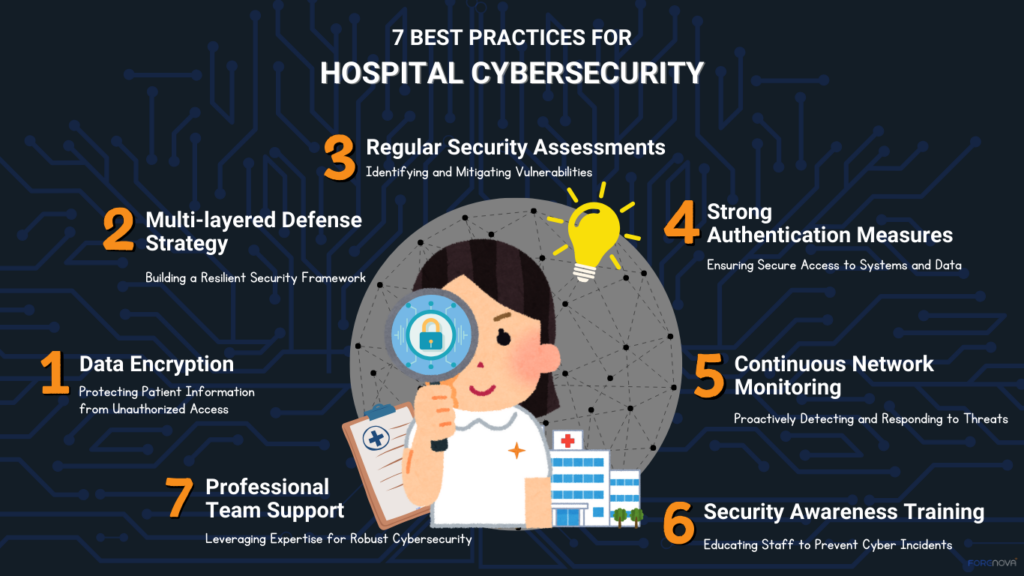
Data Encryption: To better protect against data interception and tampering during transmission, hospitals should ensure that all data is encrypted during transmission.
Multi-layered defense strategy: Hospitals should establish a defense-in-depth strategy that includes the use of multi-layered security controls such as firewalls, intrusion detection systems, and encryption to comprehensively protect hospital network security.
Regular Security Assessments: Hospitals should conduct regular security assessments to identify and fix vulnerabilities and potential risks in their networks.
Strong Authentication Measures: Use Multi-Factor Authentication (MFA) to improve system security by ensuring that only authorized personnel have access to sensitive information.
Continuous Network Monitoring: Continuously monitors network traffic, detects and responds to suspicious activity in real time, ensuring that security threats are detected and addressed in a timely manner.
Security Awareness Training: Hospitals should conduct regular security awareness training for their staff to prevent security accidents due to human error and to improve the overall security preparedness.
Professional team support: Hospitals should remain sensitive to emerging technologies and introduce new security tools and solutions like NovaMDR in a timely manner to continuously improve their network protection capabilities.
Cybersecurity is not static but needs to be constantly improved and updated to address the changing threat landscape. ForeNova team has a wealth of experience and expertise in the field of cybersecurity, and we are able to customize cybersecurity strategies that are best suited to the specific needs of different hospitals. And NovaMDR can provide healthcare organizations with 7×24 comprehensive cybersecurity solutions and compliance guidance to ensure that hospitals comply with various regulations while protecting sensitive data and systems.
Contact our team of professionals today and start protecting your organization from cyber threats today.
An Access Control List (ACL) is a security mechanism which is designed to determine which user or which system has the right to access a specific object or system resource, such as files, directories, network services and so on. As well as operations are allowed on given objects, including read, edit or execute. Thus, ACLs can be seen as a fundamental component of a robust security strategy.
Abonnieren Sie unseren Newsletter und erhalten Sie wertvolle Branchen-Insights, Produkt-Updates und aktuelle Analysen von ForeNova direkt in Ihr Postfach.
* Datenschutzrichtlinie
Wir verwenden Brevo als unsere Marketing-Plattform. Indem Sie das Formular absenden, erklären Sie sich einverstanden, dass die von Ihnen angegebenen persönlichen Informationen an Brevo zur Bearbeitung übertragen werden, gemäß den Datenschutzrichtlinien von Brevo.
Please wait while you are redirected to the right page...
When you visit our website, ForeNova and third parties can place cookies on your computer. These cookies are
used to improve your website experience and provide more personalized services to you, both on this website
and through other media. To find out more about the cookies we use, see our
Privacy Policy.
If you reject all cookies, except one strictly necessary cookie, we
won't track your information when you visit our site. In order to comply with your preferences, we'll have to
use just one tiny cookie so that you're not asked to make this choice again.